
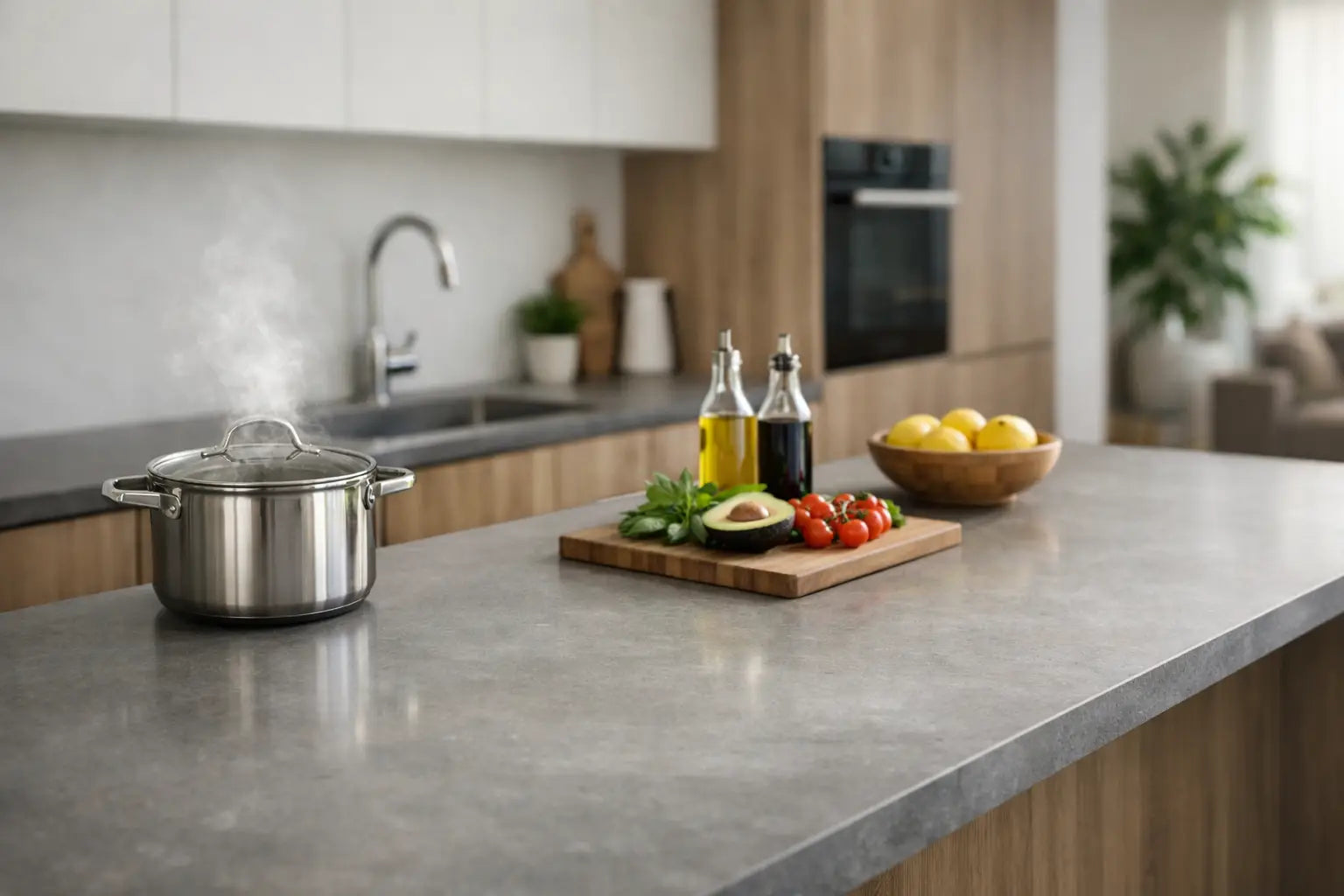
A luxury kitchen island has become more than a place to chop vegetables. It is a gathering point, a serving surface, a homework table, and often the visual center of the home. That changes the gas vs induction conversation. The question is no longer simply which heat source cooks a steak better. It is which system supports the way you want your kitchen to look, perform, and live every day.
Gas has earned its reputation through visible flame and familiar tactile control. Induction has changed expectations with rapid heating, precise power adjustment, and a surface that stays remarkably cool around the cookware. For a conventional range, either can be the right decision. For a porcelain island designed to disappear into the architecture, induction opens a category gas cannot.
Gas vs Induction: The Real Performance Difference
Gas creates heat by burning fuel beneath the pan. Some of that heat reaches cookware, while some escapes into the room and around the sides of the pan. The flame is immediate and expressive, which is why many experienced cooks enjoy it. You can see the intensity change and use virtually any cookware shape or material.
Induction works differently. A magnetic field energizes compatible cookware directly, turning the pan itself into the heat source. There is no open flame and no glowing electric element waiting to transfer heat through a glass surface. The response is fast because the cookware receives energy directly.
That difference shows up in daily cooking. Induction can bring water to a boil in under two minutes with the right cookware and power setting, then reduce power quickly for a controlled simmer. Gas also offers responsive adjustment, but the burner grate and surrounding metal retain heat after the flame is lowered. With induction, the power change is more immediate at the pan.
Neither method eliminates the need to learn your equipment. A cook who loves tossing a pan over a flame may still prefer gas. But for sauces, melting chocolate, boiling, and consistent temperature control, induction is not a compromise. It is a high-performance cooking method with a different visual language.
Heat, Efficiency, and What Happens Around the Pan
A gas burner heats the air as well as the cookware. That can be welcome in a professional-style kitchen on a cold day, but it also means more waste heat during summer cooking and greater demand on ventilation. Induction directs substantially more of its energy into the pan, commonly operating in the 83 to 90 percent efficiency range.
For homeowners, the practical result is a more comfortable kitchen. The island does not become a hot zone simply because pasta is boiling. After a pan is removed, an induction surface cools quickly because it was not the source of the heat. The cookware remains hot, of course, and residual heat can transfer to the counter surface, but there is no exposed flame or burner continuing to radiate heat.
Gas also requires thoughtful ventilation planning. Any combustion appliance produces byproducts that should be captured and exhausted properly. A serious gas range deserves a properly sized hood and ducting strategy, especially in a tightly built home. Induction still benefits from ventilation for steam, smoke, and cooking odors, but it does not add combustion to the room.
Safety Is More Than a Feature List
Open flame is a familiar risk, yet familiarity can make it easy to overlook. Pan handles, paper towels, loose sleeves, and curious children all require attention around a gas cooktop. Gas also creates an active cooking zone even before a pan touches the grate.
Induction activates only when compatible cookware is present. The surrounding surface is far cooler than a conventional cooktop during use, making it easier to work around families, pets, and busy entertaining. That matters on an island, where guests naturally gather close to the action.
This does not mean induction is consequence-free. Hot pans can burn, and a recently used pan can leave heat on the countertop beneath it. Proper cookware, correct installation, and following the manufacturer’s operating guidance remain essential. The point is simpler: induction removes open flame from the equation while preserving serious cooking power.
Cookware: The Most Common Induction Question
Gas accepts nearly everything: stainless steel, aluminum, copper, cast iron, carbon steel, and ceramic cookware. Induction requires magnetic cookware. Cast iron and most magnetic stainless steel pans work well. Aluminum and copper pans need a magnetic base to work on induction.
The quickest test is a magnet. If it sticks firmly to the bottom of a pan, that pan will generally work. Flat-bottom cookware is especially important for efficient, even contact and dependable performance.
For a luxury renovation, cookware is rarely a barrier. Many premium cookware lines are induction-ready, and a thoughtfully selected set performs exceptionally well. It is simply a purchasing consideration that should be made before installation, not an unpleasant surprise after move-in.
What about wok cooking and flame techniques?
This is where gas retains a genuine advantage for certain cooks. If your cooking style depends on charring peppers directly in a flame, flambéing, or using a round-bottom wok over high flame, gas delivers experiences induction does not replicate in the same way. A flat-bottom wok works beautifully on induction for stir-frying, but it is not the identical technique.
For most homeowners, that trade-off is outweighed by speed, control, cleanup, and design flexibility. For dedicated live-fire cooks, a gas burner may still deserve a place in the plan, perhaps in an outdoor kitchen or secondary cooking area.
Cleanup and the Everyday Luxury of a Clear Surface
Gas cooktops have grates, burner caps, seams, and corners that collect splatter. Cleaning them thoroughly takes time, particularly after a high-heat meal. Even refined gas appliances remain visibly mechanical objects on the counter.
Conventional induction improves cleanup with a flat glass surface, but it still leaves visible burner markings and a dedicated appliance plane. Through-surface induction changes the visual proposition entirely. With an approved porcelain slab and correctly planned installation, the cooking technology sits beneath the countertop. No grates. No glass panel. No visible burner circles when the system is off.
That is not decoration disguised as performance. It changes how the island works. The same porcelain surface can be a cooking area, a buffet for guests, a pastry workspace, or a clean architectural statement between meals. Invisacook California helps homeowners, designers, fabricators, and contractors validate countertop compatibility, electrical requirements, and installation details before the slab is cut or installed.
Design Freedom Is the Deciding Factor for Many Renovations
A gas cooktop announces itself. For some kitchens, that is exactly right. A sculptural range can create a focal point and signal a serious culinary space. But in a minimalist kitchen, exposed burners can interrupt the uninterrupted expanse of stone or porcelain that makes the room feel calm.
Induction allows more options. A standard visible induction cooktop keeps a clean, modern look while retaining a defined cooking zone. A through-surface system goes further, preserving the countertop’s material continuity. The island becomes multifunctional without pretending it cannot cook.
Porcelain is particularly compelling for this application because it offers a refined, durable surface and can be specified in dramatic stone looks, soft matte finishes, or monolithic large-format slabs. Compatibility is not assumed. The specific porcelain brand, thickness, fabrication details, ventilation requirements beneath the counter, and electrical planning must be confirmed early. This is a coordinated design decision, not a last-minute appliance swap.
Cost, Infrastructure, and the Right Time to Decide
Gas may appear simpler when a home already has a gas line, but a proper installation can still involve ventilation, ductwork, clearances, and coordination with cabinetry and finishes. In areas where electrification is part of the project plan, running the required electrical circuit for induction may be the more future-facing choice.
A through-surface induction installation is a premium, specialized investment. It requires approved porcelain, qualified fabrication, correct support and airflow below the counter, and careful electrical planning. That level of coordination is also why the result feels so intentional. You are not placing an appliance onto a countertop. You are designing cooking performance into the surface itself.
The best time to choose is before final countertop templating. By then, the kitchen designer, electrician, fabricator, and appliance specialist can align placement, power, cabinetry, and the way the island will be used.
So, Which One Belongs in Your Kitchen?
Choose gas when visible flame, universal cookware compatibility, and live-fire techniques are central to how you cook. Choose induction when you want faster boiling, highly responsive control, greater energy efficiency, a cooler work area, and easier cleanup.
Choose through-surface induction when the kitchen island needs to do more than cook. When it must hold a catered spread on Friday, become a family breakfast table on Saturday, and return to a flawless porcelain statement afterward, invisible design becomes a practical advantage. Start with how you want the room to function when dinner is over. That answer usually points to the right heat source.


Leave a comment
This site is protected by hCaptcha and the hCaptcha Privacy Policy and Terms of Service apply.