A hidden cooktop only looks effortless when the material beneath it has been chosen with precision. The best materials for hidden cooking must do more than complement a beautiful kitchen. They must allow induction energy to reach the pan, tolerate repeated heat cycles, and preserve the refined, uninterrupted surface that makes invisible cooking possible.
For a luxury island that shifts from cooking station to serving bar to everyday gathering place, porcelain is the clear leader. But material selection is only one part of the decision. Countertop thickness, the specific slab or brand, cookware, electrical planning, and fabricator coordination all determine whether the finished kitchen performs as beautifully as it looks.
Why Porcelain Leads the Best Materials for Hidden Cooking
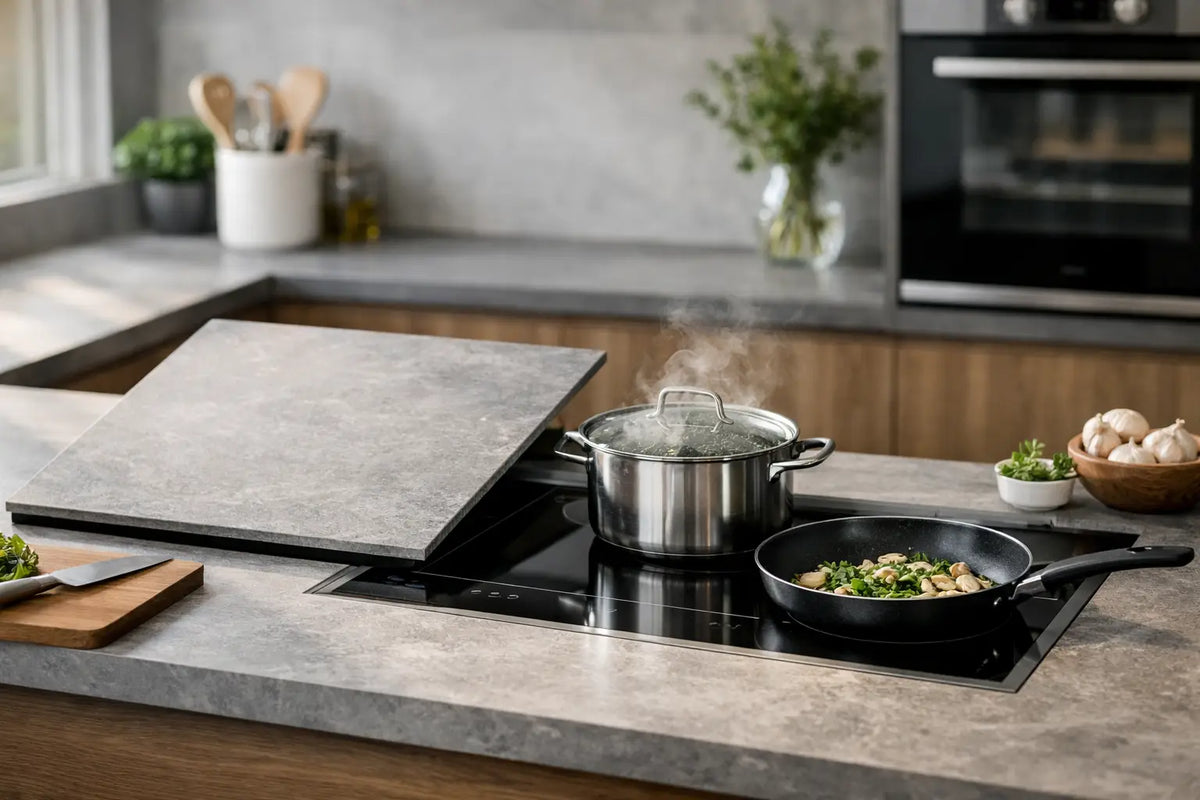
Through-surface induction works by placing the induction system beneath a countertop rather than inside a visible glass cooktop. The countertop becomes the cooking surface. When compatible magnetic cookware is placed over an active zone, the induction field heats the pan directly while the surrounding porcelain remains comparatively cool.
Porcelain is exceptionally well suited to this application because it is non-metallic, dense, heat-resistant, and engineered for demanding environments. It provides the clean architectural finish designers want while meeting the practical needs of a working kitchen.
A properly approved porcelain surface delivers several advantages at once. There are no visible burners, no raised edges, and no black glass panel interrupting the island. Cleanup is equally straightforward: once cooking is finished and the surface has cooled, it is simply a continuous countertop. For families and frequent entertainers, that means more usable space without giving up serious cooking capability.
Performance matters as much as appearance. With the right system, cookware, and installation, hidden induction can reach cooking temperatures up to 400°F and bring water to a boil in under two minutes. Induction also directs energy into the pan rather than heating the room, delivering roughly 83 to 90 percent energy efficiency.
Not Every Porcelain Slab Is Automatically Compatible
Porcelain is the preferred category, but compatibility is specific. A countertop should never be selected based solely on its appearance or a general assumption that it is porcelain. The slab’s composition, thickness, finish, reinforcement, and manufacturer approval all matter.
The induction system must be paired with an approved porcelain product and installed according to the appliance and countertop manufacturer requirements. This protects performance, supports warranty compliance, and helps avoid costly changes after fabrication. A skilled fabricator also needs to understand exactly where the cooking zones will sit before cutting, reinforcing, or installing the slab.
This is where early planning pays off. Choosing an invisible cooking system after the countertop has been fabricated can limit options. Choosing it during the design phase gives the kitchen designer, fabricator, electrician, and homeowner a coordinated plan from the start.
Materials That Require Caution or Are Not a Fit
The appeal of hidden cooking is understandable across every countertop category. A dramatic marble island, a richly veined quartzite slab, or a low-maintenance quartz surface may all look like natural candidates. Yet visual appeal is not the same as induction compatibility.
Natural stone, including marble, granite, and quartzite, can vary substantially in mineral content, density, and internal structure. Some stones contain metallic minerals or have properties that can interfere with induction performance, concentrate heat unpredictably, or create concerns around thermal stress. Their natural variation also makes consistent approval more complicated than it is with engineered porcelain slabs.
Quartz is another common question. While it is durable for many conventional kitchen applications, quartz surfaces contain resins that may not be designed for the concentrated heat exposure associated with cooking directly on the countertop. A standard quartz warranty may also exclude this use. A beautiful surface is not worth risking discoloration, damage, or an unsupported installation.
Solid surface materials, laminate, wood, concrete, and most metal countertops are also not appropriate choices for a through-surface induction installation. Some lack the required heat resistance. Others can block or disrupt the induction field. Metal is especially unsuitable because induction interacts with ferrous material, making it a poor barrier between the system and cookware.
The practical rule is simple: hidden induction is not a countertop material experiment. Use an approved porcelain surface, follow the specified installation requirements, and let the technology do what it was designed to do.
Countertop Thickness Is Part of the Performance Equation
A porcelain slab can be approved and still require careful planning around thickness. Induction energy has to travel through the material efficiently enough to heat compatible cookware with responsive control. If the countertop is too thick, the field may not couple correctly with the pan. If it is too thin or improperly supported, structural and fabrication concerns can arise.
This is not a detail to leave until installation week. The desired porcelain thickness should be confirmed alongside the hidden cooktop model, the burner layout, and any buildup strategy for the island. A countertop may appear thick at the edge while using a different thickness over the active cooking area. That design approach can be useful, but it must be engineered correctly.
The underside of the slab also needs adequate space for the induction unit, ventilation, and service access. A full-depth drawer directly beneath the cooking zones may need to be redesigned. Decorative panels, structural supports, and adjacent appliances all need to respect the required clearances.
A successful invisible kitchen does not ask the appliance, countertop, and cabinetry to compete. It gives each component a defined role before fabrication begins.
The Cookware Matters Just as Much as the Surface
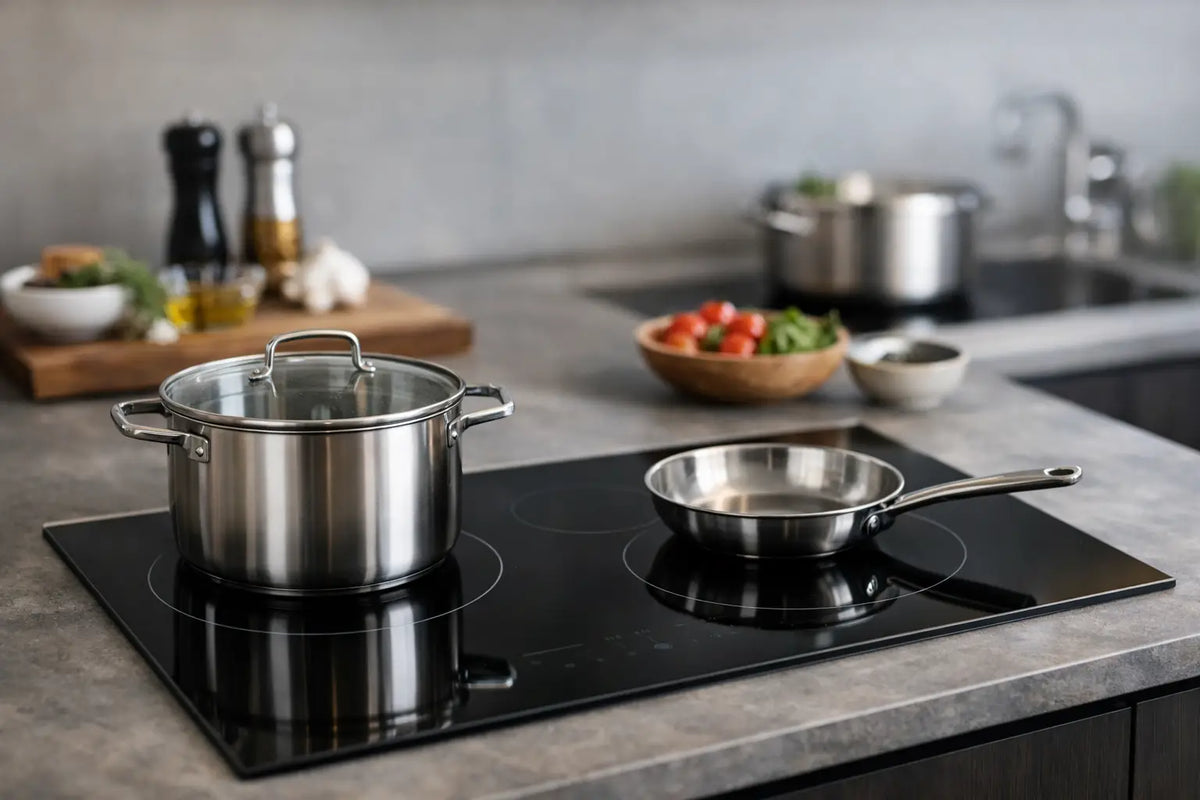
The countertop can be flawless and the installation can be technically perfect, but hidden induction still needs compatible cookware. The pan base must be magnetic. Cast iron and many stainless-steel pans work well, while aluminum, copper, glass, and ceramic cookware generally need an induction-compatible magnetic base to function.
For a concealed cooking zone, flat-bottom cookware is especially valuable. It creates reliable contact with the marked cooking area and helps deliver even, responsive heat. InvisaCookware is designed for this purpose, with cookware dimensions and magnetic construction intended to support through-surface induction performance.
Cookware size should also align with the selected burner configuration. A larger pan can be excellent for entertaining, but it needs to sit within the active zone parameters. This is one reason a one-burner system and a four-burner system serve very different kitchens. The right choice depends on how the household cooks, not simply on the size of the island.
Design for Cooking, Then Enjoy the Empty Countertop
The best hidden kitchens look minimal because the planning behind them was not minimal. Start by deciding how the island will be used when cooking is happening. Will it support a single sauté pan for weeknight dinners? Multiple pots during holidays? A demonstration-style cooking zone facing guests? Those answers determine the number and placement of burners.
Next, consider how the island works when no one is cooking. This is where porcelain and hidden induction change the room. The same surface can serve as a pastry station, a buffet for guests, a homework counter, or a clean dining surface. Optional integrated features such as through-counter wireless charging can extend that multifunctional approach without adding clutter.
Visual zone markers are another design choice. Some homeowners prefer subtle markings that make cookware placement intuitive. Others want the most uninterrupted appearance possible. Both approaches can work, provided the cooking zones remain clear to the people using them.
Coordinate the Right Team Early
A hidden induction project benefits from a short, focused conversation among the homeowner, designer, fabricator, electrician, and appliance specialist. Confirm the approved porcelain selection, final slab thickness, cooktop location, electrical requirements, cabinetry clearances, ventilation needs, and installation sequence before fabrication begins.
This coordination is particularly valuable in a renovation where the island is the centerpiece of the kitchen. Moving a standard cooktop opening is inconvenient. Revising a fabricated porcelain island after the fact is far more disruptive. Invisacook California helps homeowners and trade professionals validate those details before the system is ordered, with direct support from selection through installation.
A Better Material Choice Creates a Better Kitchen
Porcelain is not simply the best-looking answer for hidden cooking. It is the material that makes the concept practical: a durable architectural surface above, fast induction performance below, and no visible burners in between.
If you are planning a premium kitchen island, choose the countertop and induction system as one decision. The result is not just a cleaner cooktop. It is a kitchen with more space to cook, gather, serve, and live.

Leave a comment
This site is protected by hCaptcha and the hCaptcha Privacy Policy and Terms of Service apply.